



Summarise with AI:



As introduced under Commission Implementing Regulation (EU) 2021/1963, safety Management Systems (SMS) are a formal part of the regulatory framework for EASA Part-145 organisations. In simple terms, in the past, regulatory compliance for maintenance organizations focused mainly on aircraft maintenance quality, operational safety, and record keeping.
First, all approved maintenance organisations were required to have an SMS implemented by December 2024.
Now, organizations must also protect digital maintenance records, IT systems and networks, maintenance software, sensitive operational data, and electronic communications and documents.
Organizations must be able to identify, manage, and respond to security incidents, and these requirements became mandatory on 22 February 2026 for organizations within the regulation's scope.
This means:
- The information must be documented
- Related information should be connected.
- Information must remain, accurate, current, and secure, and accessible only to the authorised personnel.
Suppose a technician reports the same component failure several times. If each report is stored separately, the organization may not realize there is a recurring issue. If it is recorded in a digital system and linked to maintenance records, the organization can identify the pattern and take action.
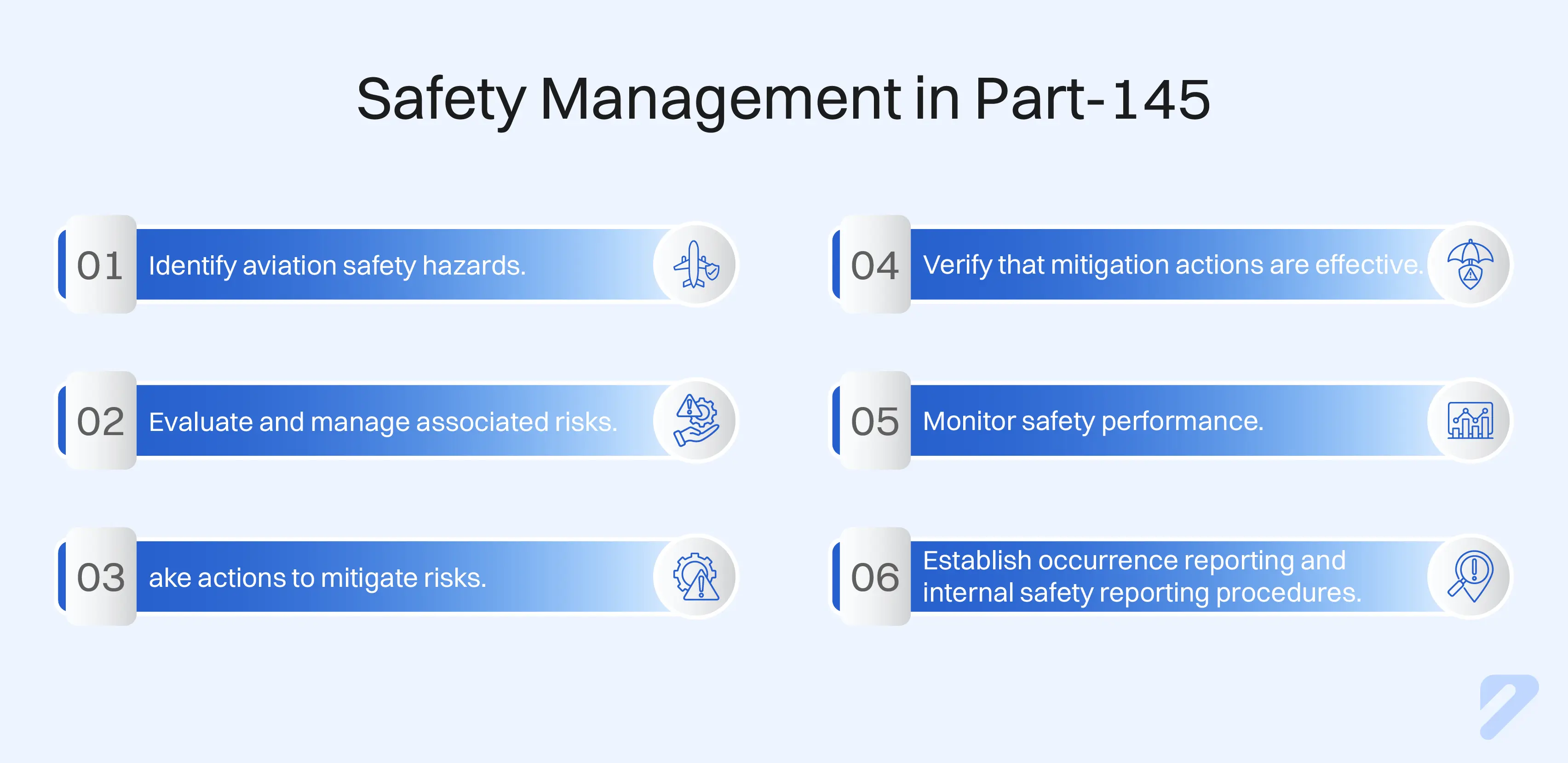
At a basic level, safety management in a Part-145 environment is about understanding what could go wrong, assessing the risks, and taking corrective actions. That does not happen only through a safety meeting or an annual review.
Safety-related information can emerge from everyday activities. As you know, Part-145 rules require organizations to keep detailed and structured records of the work. So, they can demonstrate that their process aligns with regulatory requirements.
This is where safety management and maintenance operations start to overlap. For example; a technician finds out the same defect several times. From a maintenance perspective, the defect is repaired and recorded.
If it occurs multiple times, from a safety management perspective, the organization should ask why this defect is recurring.
The information needed to understand an issue may already exist in the maintenance process. The challenge is making sure that information is easily accessible, secure, and connected to the maintenance activity.
Small Gaps Can Lead to Big Problems
A maintenance finding may appear to be minor when viewed on its own.
This could be understood as an example. Let's assume a technician records a recurring defect and document it. During a separate maintenance task, the inspector notices a similar issue. Now the component is sent for repair. These three records should be linked as they are related to the same issue.
If those records exist in parts in paper forms, spreadsheets, emails, and separate systems, establishing the connection can take considerably more manual work.
If the information is linked to the relevant work orders, components, personnel and maintenance records, the organisation has a much clearer basis for investigating the issue.
This is important because an SMS depends on more than simply recording that an event happened. As already stated, that organisation must have a safety management system in place. Also, organizations must report and track events.
The Part-145 management system requires maintenance organizations to actively manage safety risks and to report, investigate, and learn from safety-related incidents and occurrences. These processes help organizations improve safety and prevent future problems.
Manual vs Digital Safety Information: What's Changed?
The difference is not simply between paper and software. A paper-based process can be controlled, and a digital system can still create problems if it is poorly designed. The more useful comparison is how easily the organisation can capture, connect, retrieve and control safety-related information.
| Maintenance activity | Manual or disconnected approach | Digital MRO approach |
|---|---|---|
| Recording | Finding recorded on a separate form | Finding recorded against the work order |
| Following issue | Staff compare previous records manually | Records can be linked and searched |
| Tracking | Status may be maintained through spreadsheets | Action and status can remain connected |
| Approval | Signatures and records reviewed individually | Performer, approval and related records linked |
| Maintenance history | Staff search through different records | History can be retrieved from a central record |
| Review or audit | Documents need to be collected and checked | Records can be retrieved with audit trail |
This does not mean that EASA requires every Part-145 organisation to use a particular type of digital MRO platform. The regulations establish requirements for areas such as maintenance records, maintenance data, management systems and information security; organisations determine how they meet those requirements through their procedures and systems.
The important point is that digitalisation can change how easily an MRO can manage information that already matters to safety.
For example, EASA's guidance on maintenance data requires organisations to control the amendment status of documents being used and to establish procedures for keeping maintenance data up to date. A digital workflow can support this by connecting the work being performed with the applicable instructions and their revision status, rather than leaving staff to establish those connections manually.
The same principle applies to maintenance records. If a work order, finding, inspection, approval and supporting document are connected within one workflow, the organisation has a clearer record of what happened and when.
Conclusion
Safety management is more than collecting records. Organisations must have an established process. The system you are using must allow information to remain accessible, and traceable.
As Part-145 organisations continue to develop their management systems, many are evaluating how their maintenance processes support the information needs of safety management.
Solutions such as ProxiMRO are designed to help maintenance organisations manage maintenance records, workflows and operational information in a more connected environment, supporting the visibility and traceability that modern MRO operations require.