



Summarise with AI:



Maintenance records are one of the most important sources of information in the MRO industry. Every task needs to be recorded, stored in a structured way, and readily available. Much of this information today is managed through paper forms, printed work orders, physical logbooks, spreadsheets, and document folders in the MRO industry. But the traditional approach proves to be inefficient considering current demands and expectations.
There is a lot of friction that could be avoided through digital maintenance records. Information retrieval is not immediate with the old-school way. One may need to go through folders within folders just to track down a document.
The foundation of digitalisation is making information easy to record, organize, and access, before further transformation takes place. The rationale is that the effectiveness of digitalisation is only as good as the quality of data.
When you are trying to solve a problem, the decision should be made with consideration of how it solves the problem. This way, you can achieve what was intended with the program.
The transition is therefore not an IT upgrade. It demands a clear understanding of the pain points you are trying to eliminate, rather than simply following the trend toward digitalisation.
The transition from paper to digital is therefore not just an IT upgrade. It represents a change in how maintenance information is created and used.
The Consistent Challenge Paper Maintenance Records
Paper maintenance does not require tech competence from operators. But their disadvantages become more apparent.
1. Records can be difficult to find
It may take one’s significant amount of time to search through files, folders, cabinets, or archives. Operators put in considerable effort during audits. On the other hand, the process becomes remarkably seamless with software, taking the load off your shoulders and handling in moments what would otherwise demand considerable time and effort.
2. Manual data entry creates opportunities for errors
Manual paper-to-system transfer creates another opportunity for mistakes. Data entry errors and poor data quality cost U.S. businesses an estimated $3.1 trillion annually.
3. Physical storage becomes a growing burden
A single component overhaul can generate over 50 different paper documents, all of which must be retained in line with regulatory requirements. The volume of records becomes a storage challenge beyond a certain point, when buried in filing cabinets and paperwork.
4. Information becomes fragmented
Fragmented information has grown into an industry-wide challenge. Information is spread across multiple corners of the organization leaves teams with only pieces of the bigger picture. A technician may have one document, the quality department another, and an administrative team may maintain a separate spreadsheet.
5. Paper slows down workflows
Unlike digital records that are available at the click of a button, physical documents are physically constrained; therefore, they require physical handling through a series of manual handoffs. Each additional movement creates another point at which time can be consumed, and delays can accumulate.
How Digital Records Makes an Impact
As digital maintenance records prove to be better suited to managing an ever-growing flow of data, MRO organisations are increasingly embracing digital route to create a more structured and efficient approach to record management.
1. British Airways: E-Logs reduced downtime and delays
In 2024, the British Airways by adopting an E-logs system, reportedly eliminated the need for more than 900,000 pieces of paper a year.
2. Qantas paperless maintenance reduced documentation errors
Qantas transition to electronic records improved record management and reduced errors associated with handwritten maintenance entries.
3. Lufthansa Technik: Digital records improved customer service
Lufthansa Technik integration AVIATAR, AMOS, and flydocs, streamlined internal processes, and enhanced audit readiness.
What Do Digital Records Mean in an MRO?
Let’s first understand what digital records mean. It is important to know that we are not talking about scanned paper documents. If users cannot easily search for information, it is of no use. In such an environment where documents are stored in a fragmented way, many of the benefits of digitalisation are locked.
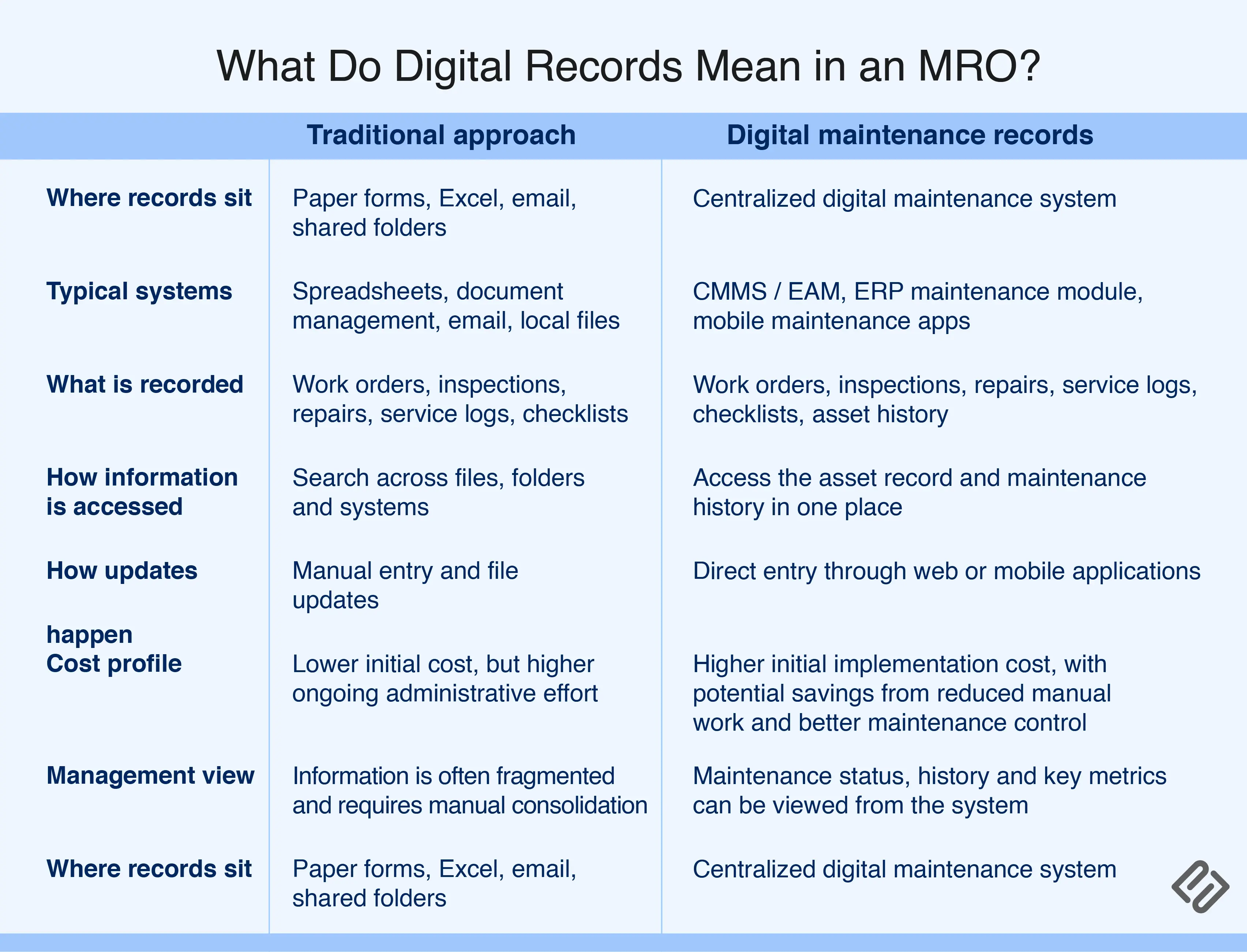
When these records are connected, an MRO can build a more complete digital history of its maintenance activity. Teams understand what work was completed, when it was completed, which asset or component was involved, and who was responsible for the relevant activity.
How to Start Digitising Maintenance Records
Digital MRO transformation can happen step by step rather than all at once. In fact, a phased approach can be more practical, particularly for smaller MRO organisations.
Step 1: Map the existing process
Check your foundation first, before you start this initiative. Walk the floor and list your equipment in a proper manner using clearly defined categories and fields such as name, reference, and any important details attached to them. This may take days to weeks, depending on the number of assets you have.
Identify:
- Where records are created
- Who enters information
- Who reviews and approves it
- Where records are stored
- How records are retrieved
- Where delays commonly occur
- Which processes generate the most paperwork
This is baseline to start any digitalization project.
Step 2: Identify high-value processes
Not every process needs to be digitised simultaneously. Start with areas where paper creates the greatest operational burden. Work orders, inspections, task cards, component records, and frequently accessed documents may be good candidates.
The objective should be to demonstrate measurable improvements rather than simply digitising paperwork for its own sake.
Step 3: Define your requirements
Before looking into MRO software, paint a clear picture of the desired outcome.
Ask yourself questions like:
- Which records need to be at your fingertips?
- Who needs access to each type of information?
- What approval workflows are required?
- What information needs to be captured at the point of work?
- What reporting capabilities are needed?
- Which existing systems need to be integrated?
- What security and audit requirements apply?
Clear requirements make it easier to compare solutions.
Step 4: Choose software that fits the workflow
Technology should support the maintenance process rather than make it more complicated. The ideal solution must be intuitive for technicians and practical for administrative and quality teams.
Mobile accessibility can also be valuable when technicians need to enter or retrieve information directly from the maintenance environment.
Step 5: Train users and manage the transition
If employees don’t know how to use the tools you have introduced, they are more likely to go back to the old way of doing things. Run a pilot training program for everyone involved. A gradual rollout, practical training, and feedback from users can smooth the path forward.
What Changes When Maintenance Records Become Digital?
- Digital records can make it easier for authorised users to find information.
- This can optimise time for technicians and everyone who is supposed to be using it.
- They create a clearer record of maintenance activity.
- Teams would spend less time passing information
- It gives managers a better visibility into moving parts of the information.
Perhaps the biggest long-term advantage is that digital maintenance records can become useful data rather than information that simply sits in an archive. Once information is structured, organisations can use it for operational improvement.
Why PrioxiMRO is a Practical Solution for Small MROs
For smaller MROs, adopting new technology can be expensive. It is often complicated for those from a non-tech background. That’s why custom solutions are still exclusive in the age of AI, where product development is easier than ever before. But they are still not affordable for many, considering the resource investments to manage hardware, software, maintenance, cybersecurity, and technical expertise.
PrioxiMRO is an practical alternative for those who want to improve productivity with limited investment. It provides an organisation access to software while the provider manages and updates it.
- Lower upfront complexity
- Easier scalability
- Regular software updates
- Remote accessibility
The Future of Digital MRO Records
Digital maintenance records are likely to become increasingly important as MRO organisations adopt more connected technologies. Once maintenance information is available digitally and consistently, it can potentially be connected with other systems and technologies.
For example, digital records can provide a foundation for better maintenance analytics, automated reporting, mobile maintenance workflows, inventory visibility, and other data-driven processes.
This creates an important distinction between going paperless and becoming a truly digital MRO. Going paperless means reducing physical documents.
Becoming digital means creating connected, accessible, structured, and useful maintenance information.The second approach has much greater long-term potential.
Conclusion
The move from paper to digital maintenance records is becoming an important step in the evolution of the MRO industry.
Paper records still play a pivotal role in supporting business performance and growth.
in regulated industries such as aviation MRO. Paper records are unlikely to be eliminated entirely.
The challenge with paper records becomes increasingly apparent as the volume of information grows. Beyond a certain point, physical records can create considerable friction in everyday operations.
Digitalisation therefore becomes a practical step towards reducing this burden. Organisations can focus on moving information that is suitable for digital management away from physical formats, allowing paper to be retained where its physical form remains necessary.
Digital maintenance records offer a more efficient approach. They can make information easier to access, improve traceability of parts, reduce administrative work, increase operational visibility, and turn historical maintenance information into useful data.
For small and growing MROs, PrioxiMRO provides a practical path to begin this transformation without necessarily taking on the complexity of building and maintaining a large in-house technology infrastructure.