



Summarise with AI:



One moment, everything is running properly. The next moment, an urgent task is assigned. Maintenance rarely follows a perfect schedule. These unexpected disruptions are part of the business.
Labor shortage is a widespread challenge in this industry, as highlighted in the Oliver Wyman MRO survey. Effective scheduling helps teams respond to unexpected surprises without losing momentum. Businesses today use what are known as standard scheduling practices laid out by industry experts for optimal resource utilization, which we will talk about in this article.
In the MRO, this is a persistent challenge owing to the fact that it is grappling with a shortage of skilled workers.
Importance of technician scheduling in MRO
The industry is facing mounting pressure due to rising maintenance demands. For maintenance organizations working on a new generation of complex machines with a limited pool of skilled technicians, the bigger challenge is ensuring technicians are available when unexpected work arises.
The Aviation MRO industry is heavily manual. The inherent rigidity of the MRO business leaves little room to innovate. Most organizations still manage MRO maintenance schedule planning the way they did a decade ago.
For small MROs, the impact is even greater because their teams are lean. One experienced engineer might be the only person with a specific approval, the only one who knows a particular aircraft type, or the only person available to carry out a certain inspection or certification task. So, scheduling isn’t just about counting how many people are available. It’s about making sure the right person, with the right skills and approvals, is available for the job.
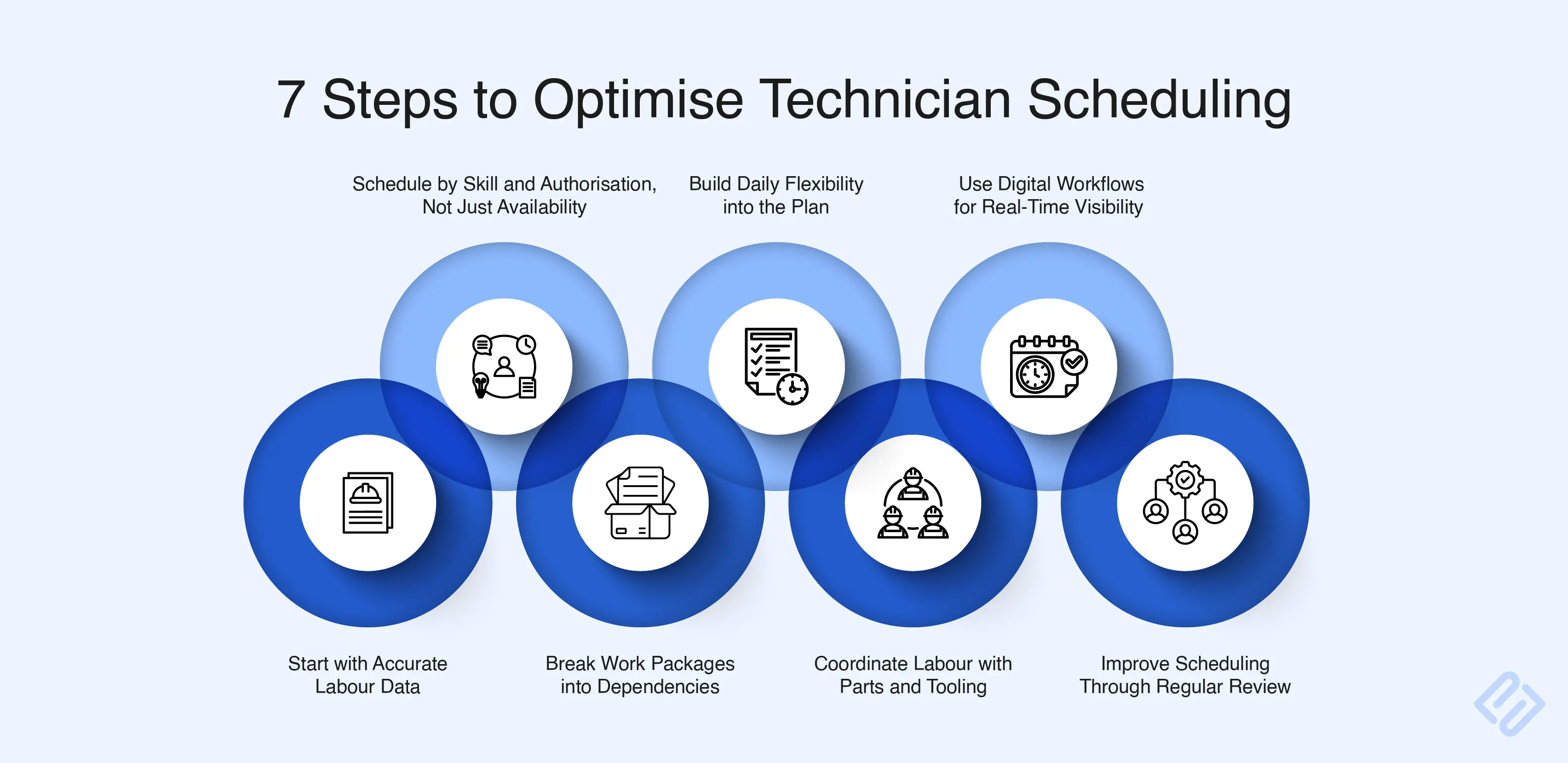
When those factors are managed in one connected workflow, a small MRO can reduce avoidable waiting time, improve first-time completion, and provide customers with more reliable maintenance forecasts.
Start With Accurate Labour Data
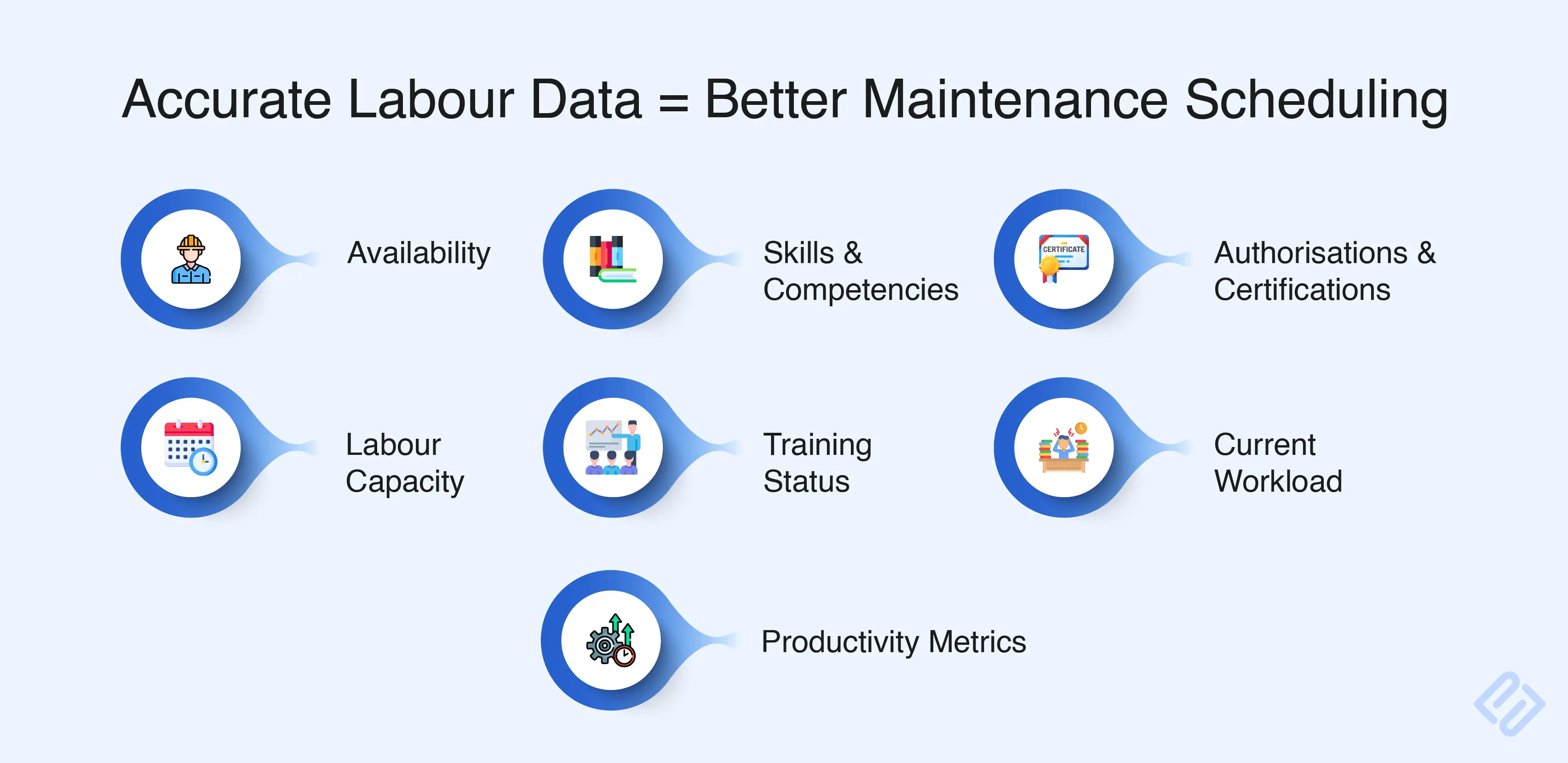
Scheduling quality depends on the quality of the information behind it. If task estimates are vague, the scheduler will be forced to make decisions based on assumptions.
Start with this. For recurring work, plan reliable estimates. Organizational data you can use to predict future failures and improve maintenance planning. Over time, an MRO should be able to compare planned vs actual hours.
For example, if a 100-hour inspection is planned at 20 technician-hours but takes 30 to 35 hours, the issue may not be technician productivity. This estimate may not include all maintenance activities. Using past data helps the MRO account for these activities and produce more realistic estimates.
A capable MRO software system can help capture planned versus actual labour at task level, giving management a clearer view of performance without relying on scattered spreadsheets or memory.
Schedule by Skill and Authorisation, Not Just Availability
A common scheduling mistake is to treat available technicians as if they can do the
same work. Assume two technicians are available, but only one is approved to perform a certain task. This can delay work. A better approach is to keep a current skills and authorisation matrix. It should show:
When creating the schedule, assign the people with the most important approvals first. If a job needs a specific certifying engineer, inspector, or specialist, make sure that person is available before assigning the other work.
This prevents a schedule from looking complete on paper but getting stuck later because the right person is not available to approve or inspect the work.
For small MRO shops, cross-training can also help. Training technicians in more than one area does not remove the need for formal authorisations. However, it can reduce delays when only one person is qualified to handle a certain task or aircraft type.
Break Work Packages Into Dependencies
Don't plan large jobs as one task. Break them into smaller tasks. A routine inspection may involve steps as following:
- Remove panels to gain access.
- Carry out the inspection.
- Fix any defects that are found.
- Reassemble the panels and equipment.
- Carry out functional tests.
- Review the maintenance records and documents.
- Complete the required certification.
If the whole job is a 40-hour activity, it is hard to know its current stage. It becomes easier to manage and track when broken into smaller tasks. It gives better visibility over task status and maintainers' activities.
Build Daily Flexibility Into the Plan
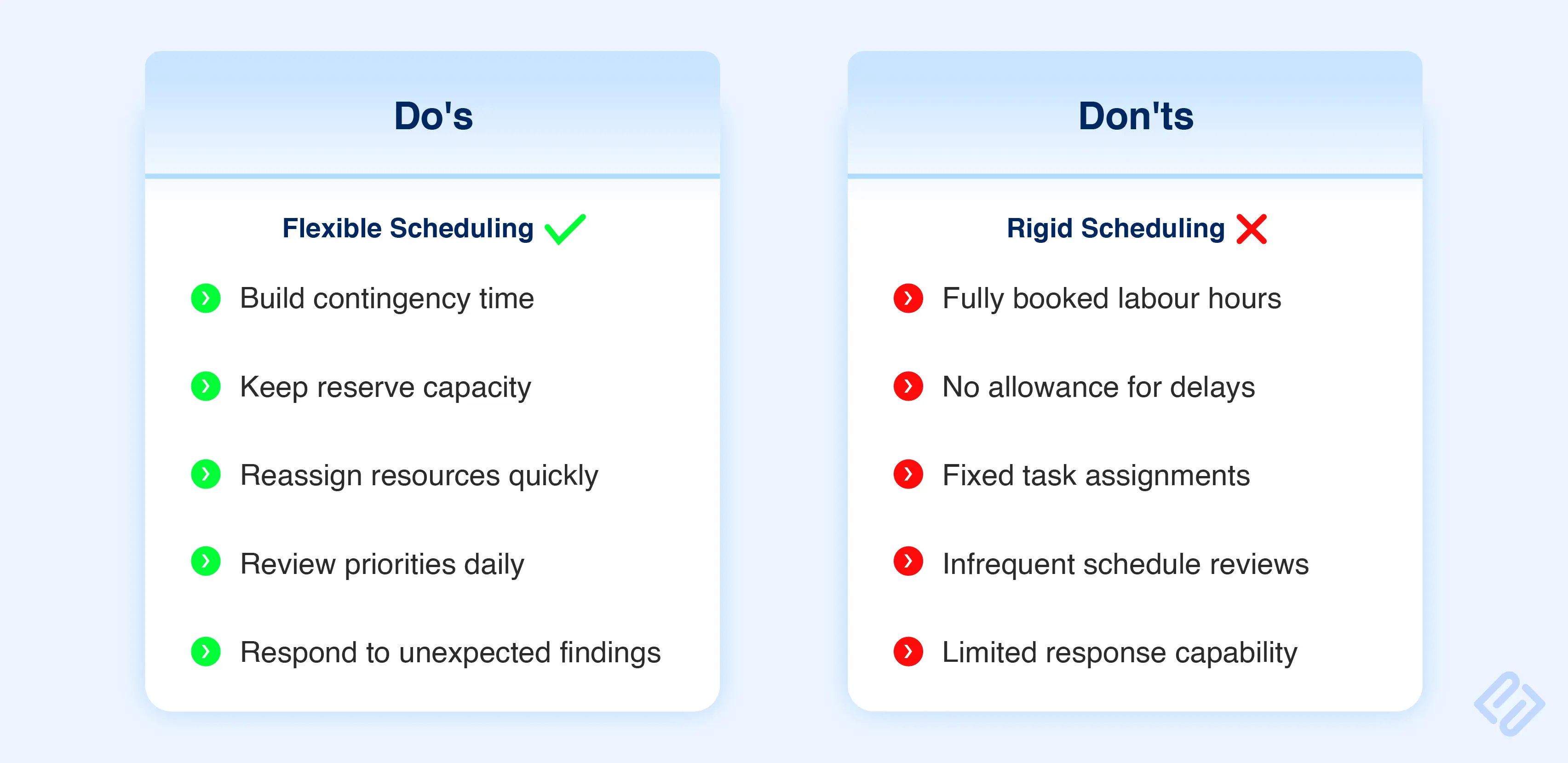
No MRO schedule works exactly as planned. Unexpected defects, customer requests, late parts, new findings, bad weather, and changes to aircraft operations are normal.
Avoid scheduling every technician to 100% of their available working time. A fully booked schedule may be efficient, but it leaves no time for planners to work on unexpected defects. When something goes wrong, the delay can quickly affect other jobs.
Many small MROs benefit from keeping some daily capacity free for unexpected work. Use past maintenance data to understand how much unplanned work normally occurs. This helps the team plan for it instead of treating every unexpected job as a surprise.
Daily planning meetings should be short and focused on the work. Review:
- Aircraft status
- Work completed
- Open defects and findings
- Technician availability
- Parts that are still needed
- Upcoming inspections
- Jobs that may be delayed
The main goal is to make decisions early, so technicians know their priorities when they start their shifts.
A useful question to ask every day is:
“What could stop this aircraft from being released on time?”
Finding these risks early gives the team time to act before they become last-minute problems.
Coordinate Labour With Parts and Tooling
If technicians are waiting for a part, it is one of the easiest ways to waste time. A good maintenance schedule should not assign a large amount of technician time to a job until the required parts, tools, manuals, and test equipment are ready.
Before work starts, check that:
Required parts are in stock, serviceable, and correctly identified.
Long-lead parts have expected delivery dates, and possible alternatives have been considered.
Consumables and standard hardware are available.
Special tools are available and not being used on another job.
Test equipment is calibrated and still within its valid period.
Current manuals, technical data, and work instructions are available.
The required work area, stands, docks, jacks, and ground-support equipment are available.
For larger maintenance jobs, carry out a materials readiness check before the aircraft arrives. This gives the purchasing and planning teams time to solve shortages before the aircraft is in the maintenance bay and technicians are left waiting.
Software can make this easier. The planner doesn't have to invest much time in finding out if parts are available before assigning technicians to the job.
The basic rule is simple: don't schedule people to wait. Make sure the job is ready before using technician time.
Use Digital Workflows for Real-Time Visibility
Maintenance organizations are turning to digital MRO workflows, as management through emails, phone calls, texts, and spreadsheets proved to be inefficient. But remember, digital workflow doesn’t guarantee quick success; organizational discipline is equally important. Traditional methods offer limited visibility when multiple technicians must be coordinated simultaneously.
A digital MRO such PrioxiMRO gives planners and supervisors a real-time view of work. For a small shop, the value is not complexity—it is clarity.
A practical system should help the business:
- Create and manage digital paperless work orders and task cards.
- Assign work to technicians based on availability and competence.
- Track labour hours against estimates.
- Monitor task status and outstanding defects.
- Control inventory, purchasing, and parts traceability.
- Maintain tooling and calibration records.
- Store technical records in an organised, auditable format.
- Support release documentation and compliance records.
- Produce useful reports on labour, turnaround time, work in progress, and recurring defects.
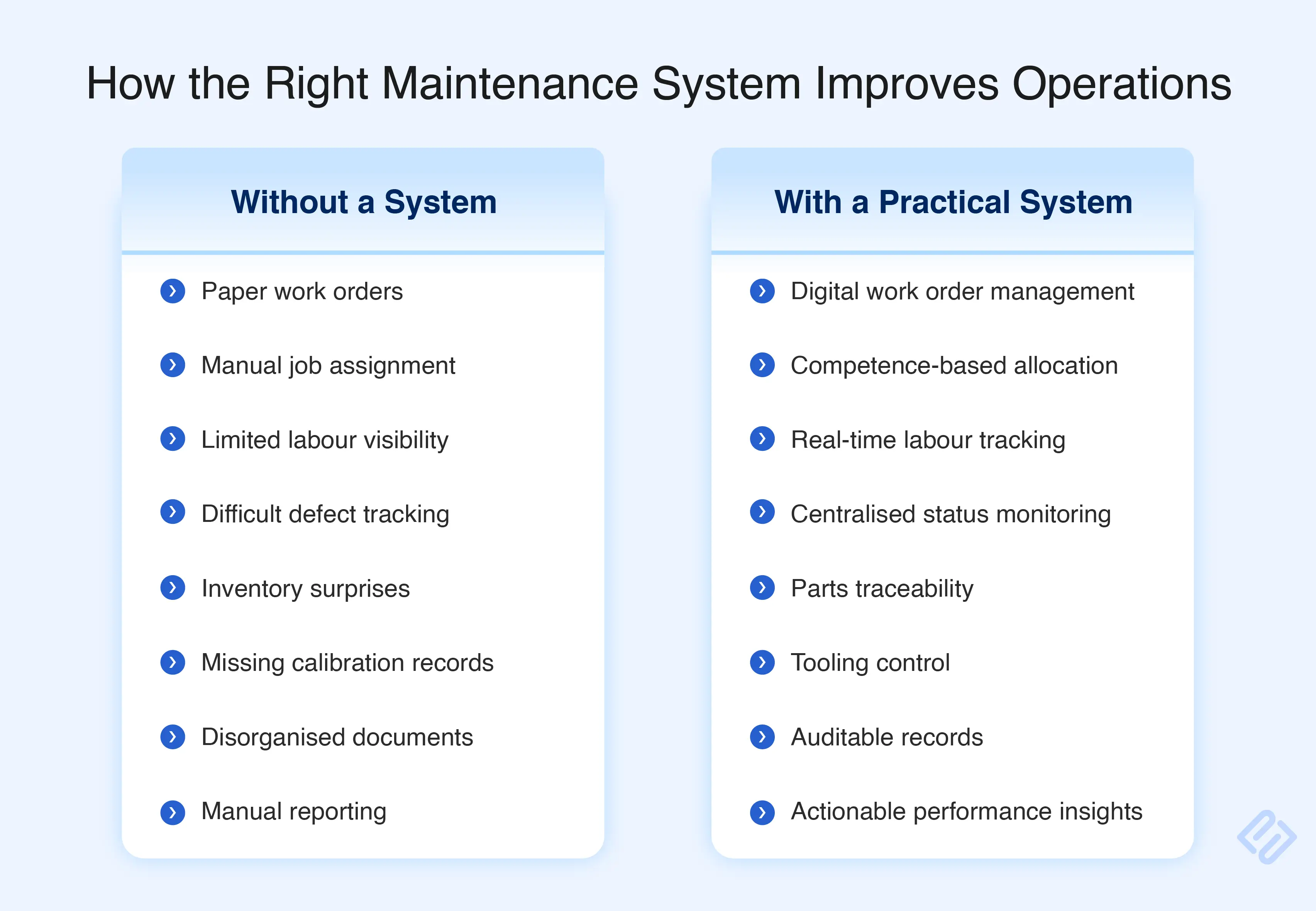
With a connected system, planning becomes an ongoing activity rather than a static spreadsheet prepared at the beginning of the week.
Improve Scheduling Through Review
The best maintenance schedule is one that improves over time. At the end of each significant work package, review the variance between the planned and actual outcome.
Ask:
- Which tasks exceeded their planned labour hours?
- Were delays caused by labour, parts, tooling, approvals, access, or findings?
- Did the schedule correctly account for inspections and certification?
- Were technicians waiting for information or materials?
- Did the same defect or delay occur on previous jobs?
- Could a task have been prepared earlier or performed in parallel?
- Was enough contingency capacity available?
This will help you improve your maintenance system. Identify the repeated issues and act on them. Start with manageable goals such as reducing one hour of waiting time or improving a common task estimate. You will notice a meaningful effect on capacity and margins over a year.
Scheduling That Supports Compliance and Growth
Efficient aircraft technician scheduling creates a realistic plan that respects the inevitable uncertainty of maintenance work. For small Part 145 MRO shops, a disciplined scheduling process can create a significant competitive advantage. It improves on-time delivery, helps technicians focus on productive work, reduces avoidable overtime, strengthens audit readiness, and gives customers greater confidence in the maintenance organisation.
PrioxiMRO helps small aviation maintenance businesses bring these moving parts together. By supporting work orders, technician activity, labour tracking, inventory, purchasing, tooling, records, and maintenance planning in one system, a purpose-built Part 145 aviation MRO software platform can turn scheduling from a daily firefight into a manageable, data-led process.
The result is simple: the right technician performs the right task at the right time, with the right parts, information, and approvals already in place.