



Summarise with AI:



Barely 15 years ago, digitalization alone was enough to give businesses a competitive advantage. It was once considered a luxury that only a select group of businesses could afford in the MRO industry.
While the dynamics of this industry have not changed much. But the world around it certainly has. Going digitally has become a business imperative. That may not be a new statement. But one cannot ignore the velocity of change. The impact of AI on businesses is too significant to ignore for business owners in 2026. This technology is beginning to create a big divide between modern businesses and those still running on traditional paper-based methods.
While not every process is mandated to be digital, in the AI era, relying on manual workflows today is like using paper charts in a GPS-driven world.
Digitalization was once a “should-have” luxury to beat the competition. Now, it has grown from being a luxury to a “must-have.” It has become an operational necessity.
Moreover, over the past few years, EASA Part-145 compliance requirements have been stipulated in a way that operators have started rethinking their traditional approach. They all push MRO operators for digitalization.
For Part-145 organizations, compliance requirements continue to evolve. While compliance has always been possible with paper-based systems, doing so is becoming increasingly challenging. All these developments indicate the urgent need for digitalization.
Though, the definition of digitalization can be subjective from person to person. For some, it could be replacing spreadsheet-based data with cloud. For others, it could be a transformative initiative, building custom solutions, or bringing in AI-capabilities into business.
So, what does all of this have to do with EASA Part-145 software requirements. Simply put, these industry and regulatory developments all point in the same direction. They highlight the growing need for digitalization of aviation MROs to meet compliance requirements more effectively.
Let’s talk about the requirements.
Maintenance, Repair, and Overhaul (MRO) organizations operating under EASA Part 145 are at a turning point in 2026, as regulatory mandates force MRO operators to adopt a digital-native MRO environment.
The days of paper logbooks and disconnected spreadsheets are being phased out; EASA itself is rolling out a new Organization Approvals Tool (OA Tool), signaling that digital-first compliance is now the regulator's own operating model.
Why Software Compliance is Crucial
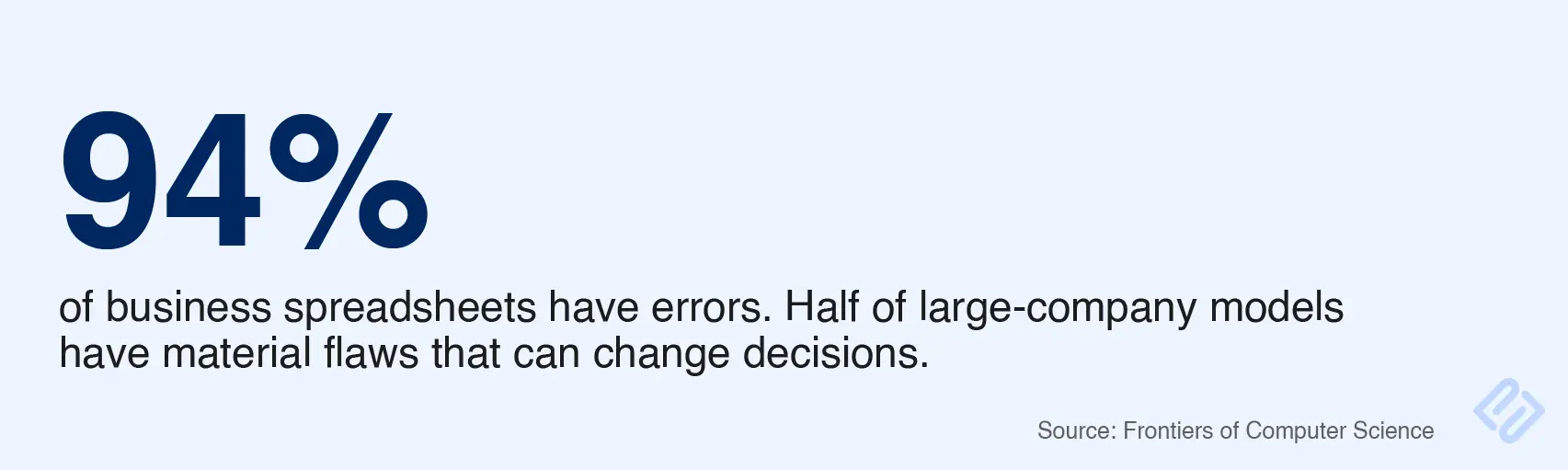
EASA's Part-145 regulation requires maintenance organizations to establish rigorous procedures for verifying the origin and history of parts, maintaining detailed maintenance logs, and keeping these records as part of the Maintenance Organization Exposition (MOE).
What has changed in 2026 is not the compliance requirements themselves, but the complexity in showing how hard it has become for an MRO organization to prove that it is compliant.
Modern cloud-based MRO systems are becoming the practical mechanism through which organizations prove airworthiness governance to auditors and authorities.
A new regulation adopted on January 15, 2026 amends Regulations (EU) No 748/2012 and (EU) No 1321/2014 hints at a move toward more digital regulatory processes.
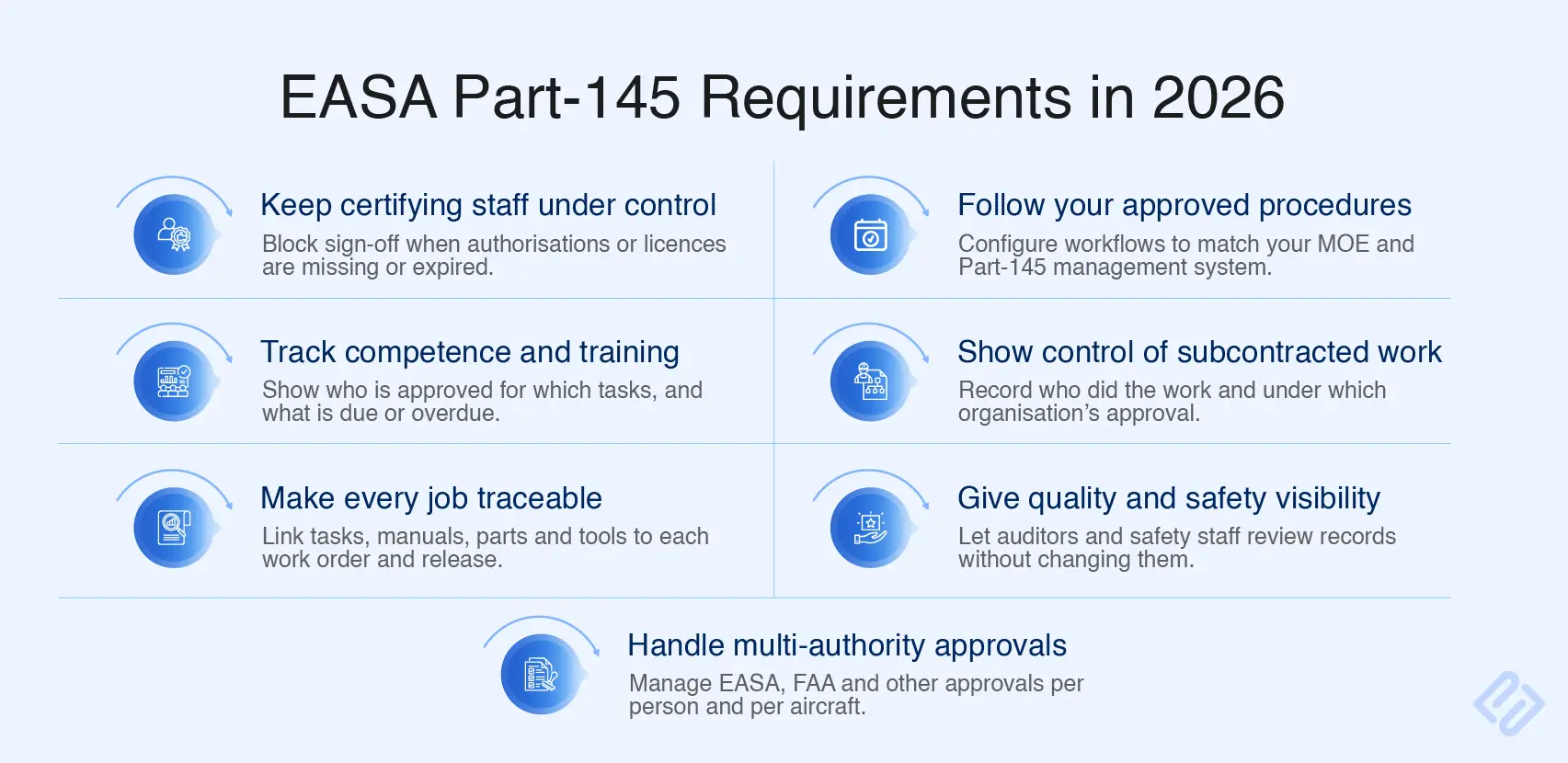
Part-IS: A new cybersecurity requirement for MRO Software
The Part-IS framework began with Regulation (EU) 2022/1645 and was completed with Regulation (EU) 2023/203, which extended information security requirements to additional aviation organizations, including Part-145 maintenance organizations.
With Regulation (EU) 2023/203 becoming applicable to Part-145 organizations on 22 February 2026, MRO organizations have limited time to put the required information security measures in place.
It regulates how information systems are used within an organization, meaning any maintenance record system, planning tool, or documentation platform can fall into scope if its failure could compromise safety. This means MRO teams can no longer evaluate software purely on functional features; they must also assess:
- Role-based access control
- Least-privilege principles for every user tier
- Data integrity and availability
- Incident monitoring mechanism
- Structured response processes
- Information security aligns with ISO/IEC 27001
Traceability and Document Control are non-negotiable
Beyond cybersecurity, the fundamental software requirement for Part 145 organizations is airtight traceability. Modern MRO teams need systems that go beyond simply digitizing records. They require you to maintain a system where every aircraft part can be traced, have a controlled approval process and robust document control.
This is because auditors will need to see a clear record or auditable trail showing how each maintenance action connects to its authorization documentation, the certifying technician, and the parts used.
MRO software records every work action, inspection, and part change automatically. It saves you investing hours in manually detailing audit trails in which each entry is time-stamped, linked to a specific user, and supporting documentation.
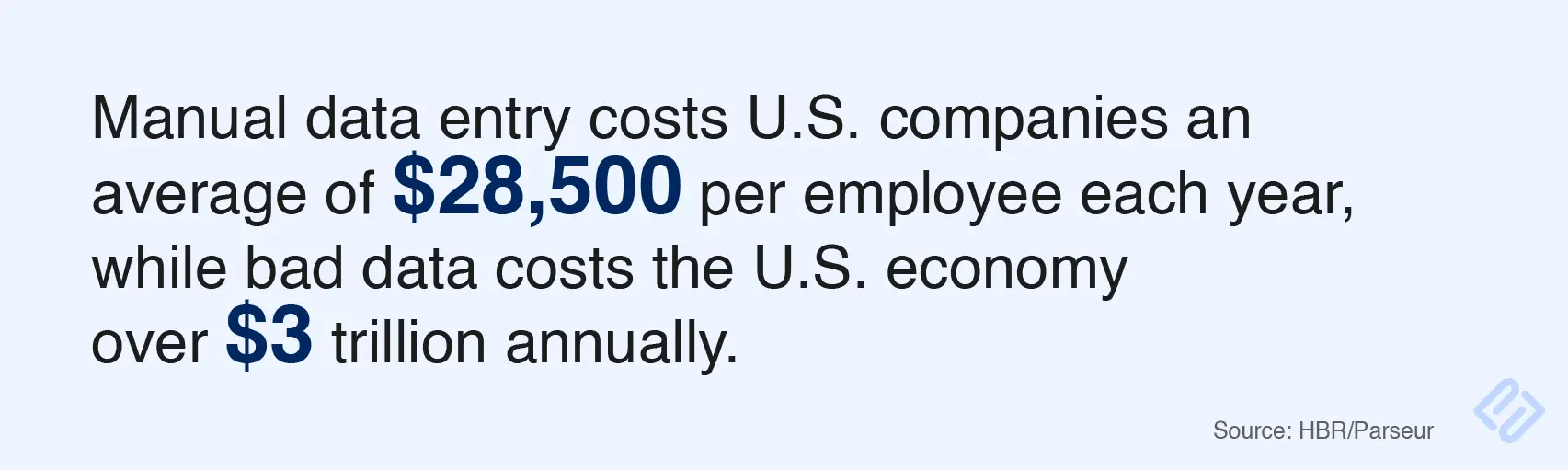
This automated approach reduces the risk of lost or incomplete records and makes critical information instantly retrievable during regulatory reviews, which is a considerable improvement over manually compiled compliance evidence.
Document control also applies to the Maintenance Organization Exposition (MOE). It simply means that if an MRO uses a content management system (CMS) for document management, the system must allow only authorized people to make changes; these changes must be traceable.
It is not negotiable because maintenance decisions and continued airworthiness depend on reliable documentation.
Safety Management System Integration
Software requirements for 2026 also increasingly reflect the mandatory Safety Management System (SMS) framework required under ICAO Annex 19 and enforced by EASA. Part 145 organizations must have a fully documented and functioning SMS that includes hazard identification, a safety risk register, and safety performance indicators (SPIs).
MRO software supports these SMS pillars — safety policy, risk management, safety assurance, and safety promotion — through centralized record keeping, workflow automation, and data visibility across the organization.
Digital Compliance Timeline for Part 145 Organizations
EASA's broader digital requirements push is being phased in gradually rather than all at once, giving organizations a runway to modernize their systems responsibly. It gives them a time window to migrate and upgrade legacy software.
| Milestone | Timeframe | Significance |
|---|---|---|
| Regulation (EU) 2023/203 cybersecurity deadline | February 2026 | Part-IS/ISMS compliance becomes mandatory for MROs |
| Airworthiness review modernization amendment | Adopted January 15, 2026 | Updates Regulations (EU) 748/2012 and 1321/2014 for digital oversight |
| Phased digital compliance rollout | 2025–2027 | Gradual introduction of digital compliance requirements |
| Full digital compliance mandate | By January 2028 | Mandatory for all Part 145 organizations |
| EASA OA Tool replacing IFP | Deployed 2026 | New platform for managing organization approvals digitally |
What Software Selection Should Prioritize in 2026
With this in mind, any MRO group that is considering an upgrade in its software should look at the bigger picture. Instead of analyzing each capability in isolation, it should view how the various capabilities interact in delivering compliant day-to-day operations.
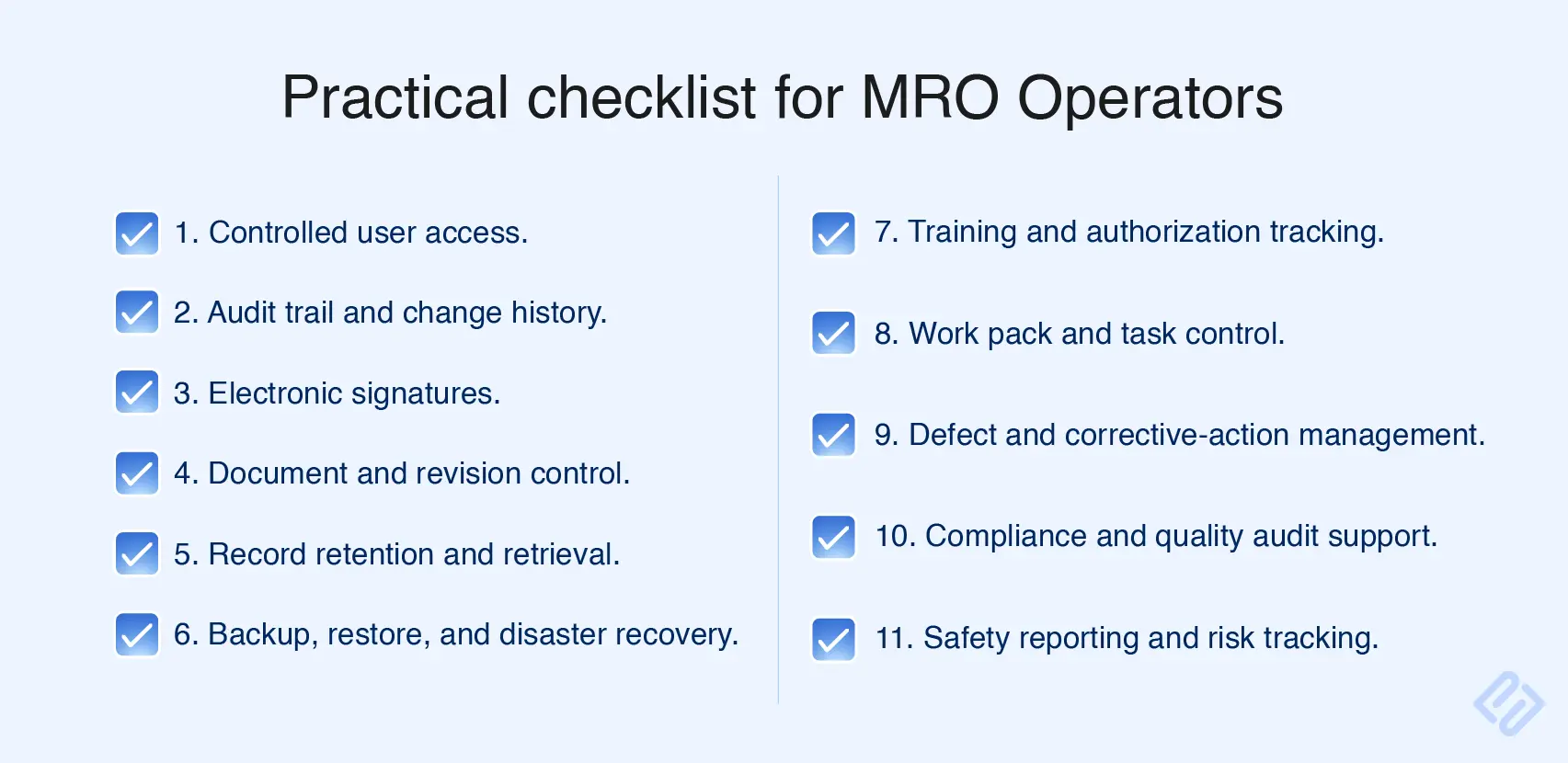
- Clear maintenance records showing who certified the work, which parts were used, and what documents supported it.
- Security features for controlling access, handling security incidents, and backing up and recovering data.
- Automatic AD and SB updates with a way to track the required work against the approved maintenance programme.
- One place to manage documents such as the MOE and other safety-critical manuals, with clear version history and controlled changes.
- SMS tools for recording hazards, managing risks, and tracking safety performance.
- Shared data across teams so maintenance, safety, and compliance teams work with the same information.
Organizations that treat these as an integrated software architecture — rather than bolting on point solutions for each requirement — will be better positioned not just to pass audits, but to catch operational issues before they escalate into safety incidents.
As EASA's regulatory framework continues tightening through 2026 and into the full 2028 digital compliance mandate, the MRO teams that invest early in Part-IS-ready, traceability-driven, SMS-integrated software will hold a clear compliance and operational advantage over those still relying on fragmented legacy tools.