



Summarise with AI:



Software now plays a larger role in business operations than it did a decade ago. They are not merely a record-keeping and administrative tools. In fact, many AI-powered systems possess the ability to reason and execute work much like a skilled human. However, these kinds of capabilities are still a distant reality in the MRO.
The MRO industry is digitally immature. Major aviation maintenance organizations operate a mix of legacy systems, and manual processes that have developed over years of operation. Only a narrow segment of MRO companies has the capability to integrate cutting-edge technologies such as generative AI.
There is another reason behind this reality is that decision-makers hesitate in software sourcing most likely because of implementation risks. Plus, a flawed implementation can cost millions.
The Digital Immaturity
A McKinsey survey of 45 MRO leaders found that only 6% had fully integrated digital business across their operations. It’s not that they lack motivation. The survey goes a step further, revealing that about half had tried and expanded several digital projects, but more than 80% said poor or limited data was a major challenge.
What Problems Should MRO Software Solve?
Don't digitize just for the sake of it. Start with the problems you're facing and then look for software. Look at where your team is spending more than required time on repetitive, low-level work. Look at these areas first. Upon identifying, you can start the exploration journey.
Airbus in on of its projects , before deciding on the technology, identified where time was being lost in the process. Only then did it bring in tools, based on whether they could make a specific task quicker or easier.
In MROs, the pressure builds in the cracks of everyday operation. Administrative tasks may consume hours of professionals’ time when they could otherwise be finished in a few minutes. These administrative frictions can delay release. Regulators mandates repair organizations to maintain records. The objective is to make the existing process easier to control and trace.
What Is MRO Software?
At a broad level, MRO software is software that helps an organisation plan, manage and record maintenance operations. In a larger organisation, it may be a end-to-end solution with separate modules for planning, work orders, inventory, purchasing, quality and compliance.
A smaller organisation may only need a basic system. It may be a maintenance solution, work orders or inventory optimization and tracking system. A typical MRO may feature planning, digital work-order creations, task assignment, tracking, and record management functions.
Aviation is a regulated industry and software make the most critical operation: traceability easier. It links the work completed, the person who performed or approved it, the parts used and the relevant maintenance records.
However, the software itself does not make an organisation compliant; it must be configured and used in a way that meets the applicable regulatory requirements. FAA and EASA rules require maintenance organisations to retain records that demonstrate compliance and maintenance history.
What Should Aviation MRO Software Actually Manage?
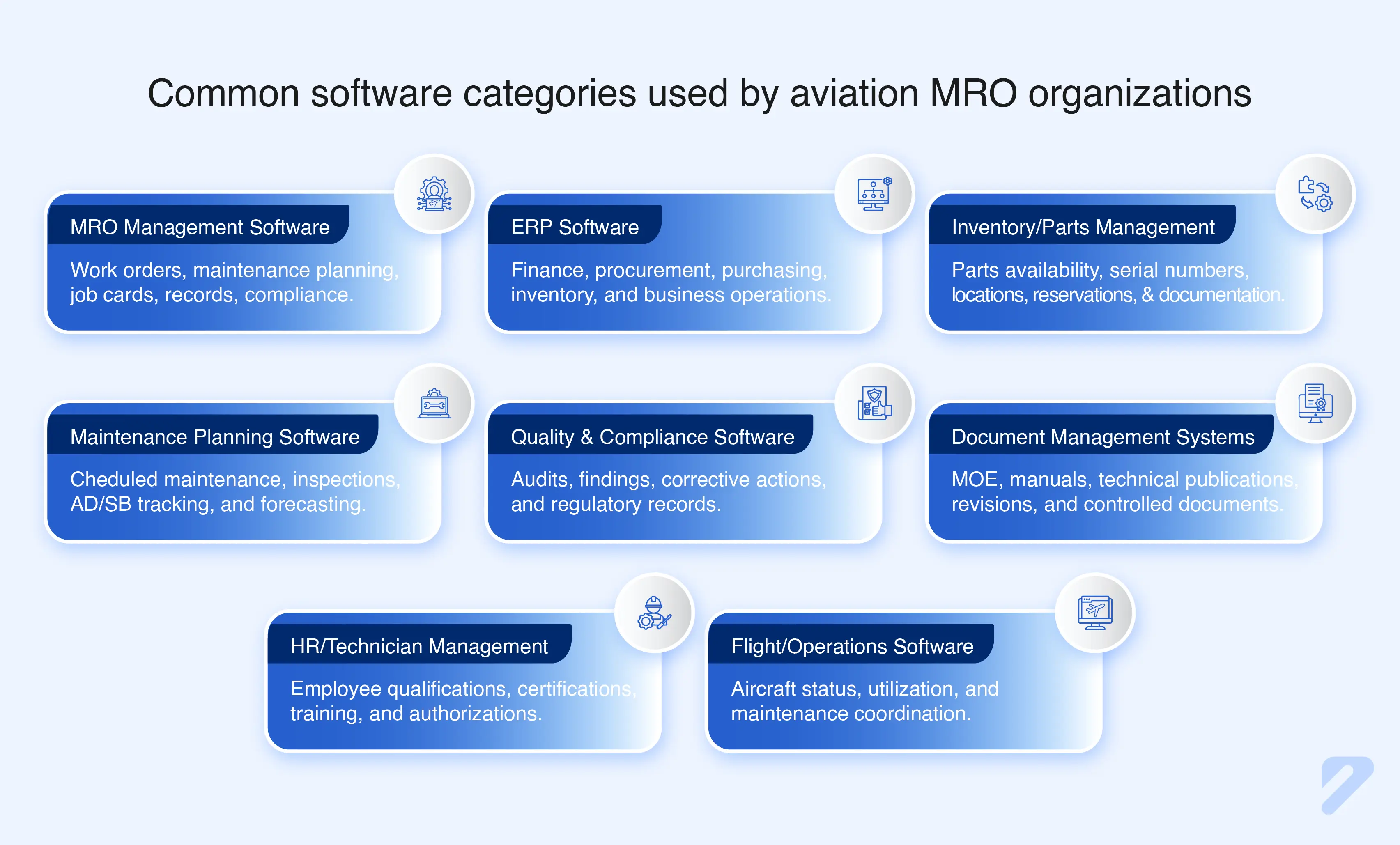
The answer depends on the type and size of the MRO. A larger organisation may need one all-in-one system for maintenance, planning, inventory, purchasing, customer services, and billing management. Specifically, large organizations may not look for tools; instead, they focus on artificial intelligence integration, cloud-native migration, and advanced cybersecurity.
A small station may only need basic software for a few areas, such as work orders, parts tracking, and digital maintenance records. Off-the-shelf MRO software is designed to handle everyday needs.
Talking about small operators, MRO software should have functionalities to manage work orders and inventory, smarter maintenance schedule planning, and features to support compliance.
It should help the team plan a job, create the work scope, assign people, track tasks and record sign-off when the work is complete. For engine shops, this can also include pre-induction checks, work scoping and kitting before the job starts.
It should also show whether parts are available, where they are, and whether material is ready for the job. For customer-facing MROs, it may also cover quotations, approvals, contract terms and invoicing.
Types of MRO Software
Not every maintenance organization needs the same type of system.
Dedicated aviation MRO software
These platforms are designed around aviation maintenance workflows and can provide functionality for work orders, maintenance planning, parts, records, personnel, inspections, and compliance-related processes.
For organizations with specific Part-145 requirements, aviation-focused software can reduce the amount of customization required to support existing workflows.
General CMMS software
A general computerized maintenance management system can work well for many industrial maintenance environments. However, aviation maintenance involves additional requirements around maintenance records, approved data, traceability, personnel authorization, components, and regulatory processes.
A general CMMS may therefore require significant configuration or additional systems to support an aviation operation.
ERP-based maintenance modules
Some organizations use an ERP platform with maintenance functionality. This can be useful when maintenance is closely integrated with finance, procurement, inventory, and other business processes.
The trade-off is that the maintenance functionality may not provide the depth of aviation-specific workflows required by an MRO organization.
Work-order-focused systems
Some systems concentrate primarily on creating and managing maintenance work orders.
These can be useful for organizations that already have separate systems for inventory, finance, or other functions but need better control over maintenance execution.
Cloud or SaaS MRO platforms
Cloud-based MRO software is increasingly attractive to organizations that want to avoid managing their own infrastructure.
Instead of maintaining servers and installing software locally, the organization accesses the system through the internet while the provider manages the underlying platform.
The important question is not simply whether the system is cloud-based. It is whether the provider has appropriate controls for access, security, backups, updates, and availability.
Cloud vs. On-Premise MRO Software
The deployment model should match the organization's operational and IT requirements.
With on-premise software, the organization generally has greater control over its own infrastructure but also takes on more responsibility for servers, maintenance, upgrades, backups, and other technical requirements.
With SaaS, much of that infrastructure management sits with the software provider.
What to Look for in an MRO Software Vendor
The software itself is only one part of the decision.
The vendor will be involved in implementation, configuration, training, support, upgrades, integrations, and potentially future changes to the system.
Look at the company's experience with aviation maintenance and the type of organizations it serves.
Ask how involved the vendor will be during implementation and what happens when your team encounters a problem after going live.
It is also worth asking whether the vendor understands the difference between simply adding a software feature and changing a controlled maintenance workflow.
A good vendor should be able to understand your operational requirements before recommending how its product should be configured. When comparing vendors, the following ten criteria provide a practical starting point.
Questions to Ask Before Choosing an MRO Software Vendor
Before making a decision, ask vendors questions that reflect your actual maintenance environment.
- Can you demonstrate our maintenance workflow rather than a generic example?
- How does the system handle a work order that is mechanically complete but waiting for inspection or authorization?
- How are technician and inspector sign-offs recorded?
- How are serialized components tracked?
- Can required parts and their documentation be linked to a work order?
- How are changes to maintenance records tracked?
- What happens to our existing records and spreadsheets during migration?
- Which systems can you integrate with?
- How are user access, backups, and recovery handled?
- What does implementation include, and what costs extra?
- What support is available after go-live?
The answers to these questions can tell you far more about the suitability of an MRO platform than a feature comparison table alone.
Conclusion
Focus on what you actually need. Look for a solution, whether it is tailored or SaaS, that optimizes operations. For small operators, a SaaS solution typically includes what they may require. These solutions are designed around common operational challenges that the majority of MROs face.
On the other hand, customized software provides a hands-on grip over every moving part of the software, providing unmatched flexibility. However, it comes with a hefty price tag.
Before choosing a vendor, map your current workflow, identify where information gets lost or duplicated, define the processes the software must support, and then test potential systems against those real scenarios.
That approach gives you a much better chance of choosing MRO software that works for your maintenance operation—not just software that looks good in a product demo.