



Summarise with AI:



Traditional MRO models built around reactive repair are hitting the limits in modern times. Meanwhile, innovative technologies are enabling MRO teams to operate faster and more cost-effectively.
But digital transformation in the purest sense is not just rolling out new technology, moving to the cloud, or introducing a new tool. Like any other buzzword, “digital transformation” can look different for different people. Consequently, if leaders don’t have clarity about what a true digital transformation is, their chances of success would be limited.
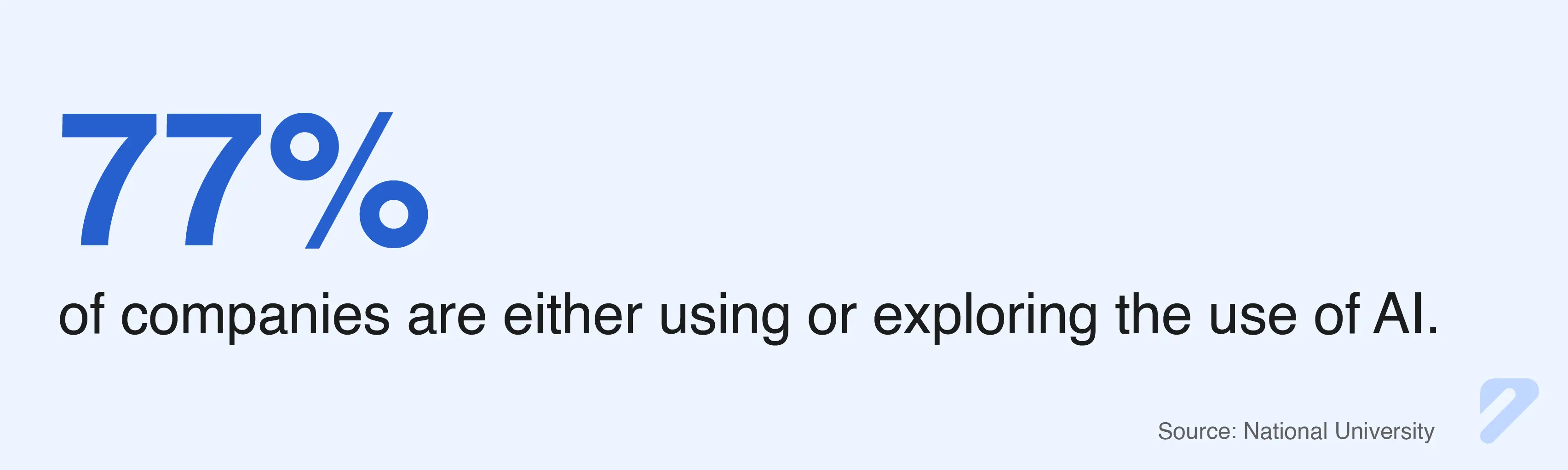
What Is MRO Digital Transformation?
Digital transformation is a long-term strategic effort to transform the way an organization adapts and grows in dynamic environments. Technology is becoming deeply integrated into business operations. By and large, transformation starts with the areas, functions, or processes that create substantial value.
This may involve decisions regarding technology selection, how to move forward, and adaptation strategy to move forward without hiccups. A modern digital MRO environment connects these processes.
Looking at it from a technology implementation standpoint, MRO digital transformation is a combination of technologies that improve information (or data) management.
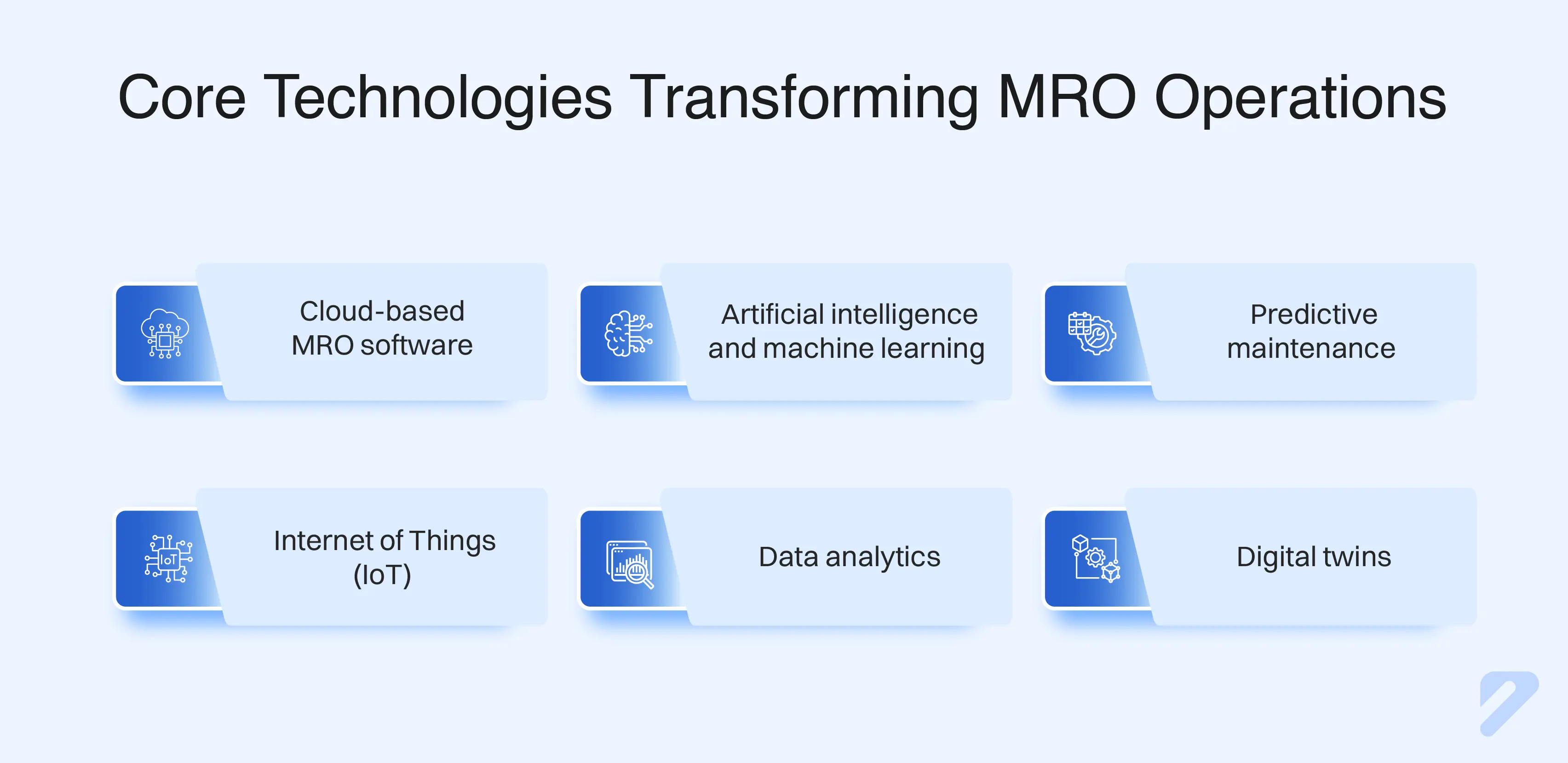
Cloud-based MRO systems break down the location-based barriers to information access by providing an environment where information can be centrally managed. Mobile applications further unlock greater capability.
The value of these systems compounds when data from aircraft, components, and maintenance activities can be connected. Internet of Things (IoT) sensors can continuously collect information, while data analytics can turn this information into useful patterns.
Artificial intelligence and machine learning take this further by helping businesses create predictive maintenance engines.
Alongside these techs, digital maintenance records, integrated MRO platforms, and workflow automation help connect individual maintenance activities into a more continuous flow of information, reducing the need to repeatedly enter, transfer, or reconcile the same information across different systems.
Why Are Legacy MRO Systems Holding Organizations Back?
Legacy MRO systems may have supported maintenance operations for years, but they can become increasingly difficult to maintain and integrate as operational requirements evolve.
The challenge with the old systems is that they operate in silos, hence providing poor operational visibility and creating blind spots that impede productivity.
Most of these systems don't automate enough, slowing down teams and making the tools feel out of sync with the speed of modern work demands. On top of that, they can’t root out our paper-based MRO processes, leaving the errors as a byproduct of manual handling untouched.
Plus, their rigid architecture and outdated technology make it difficult for businesses to adopt contemporary technologies such as ERP platforms or cloud-based solutions.
What Does a Modern Digital MRO Environment Look Like?

Larger enterprises often use comprehensive systems for core processes, alongside purpose-built software and services for specific requirements.
Comprehensive enterprise systems handle core operations while also connecting specialized software for specific business needs.
Most businesses today don't run everything through one system. They might use an ERP, a CRM, or separate tools. These systems work together through APIs, making it easier to add new capabilities without replacing the entire system.
This makes it easier for every involved authorized person to have a clear picture of ongoing work, without having to ask around or check out different systems. Furthermore, mobile apps are seeing growing interest in the industry.
Key Technologies Driving MRO Digital Transformation
Cloud-Based MRO Software
This software runs on remote servers and is accessed over the internet. Much of today’s business software is delivered through the cloud.
Cloud technology enables MRO organizations to access applications and data without depending entirely on traditional on-premises infrastructure. Today, 54% of enterprise workloads are currently running in the public cloud.
Cloud-based MRO software can support:
- Centralized maintenance data
- Remote access
- Easier collaboration
- Scalable infrastructure
- Software updates
- Integration with other enterprise systems
For organizations managing multiple facilities, fleets, or maintenance locations, cloud platforms can also help create a more consistent digital environment.
Artificial Intelligence and Machine Learning
Artificial intelligence, especially generative and machine learning tech promise, is transforming productivity across other industries. They are well suited to knowledge-based and data-intensive businesses like aviation MRO, helping professionals analyse and interpret of a wide variety of differently formatted and sourced information.
The industry is heavily experimenting with large language models and gen AI. Customer facing apps are being upgraded with AI core.
AI and machine learning are becoming increasingly important in modern MRO operations. AI can analyze large volumes of maintenance and operational data to identify patterns, detect anomalies, and support decision-making.
Predictive Maintenance
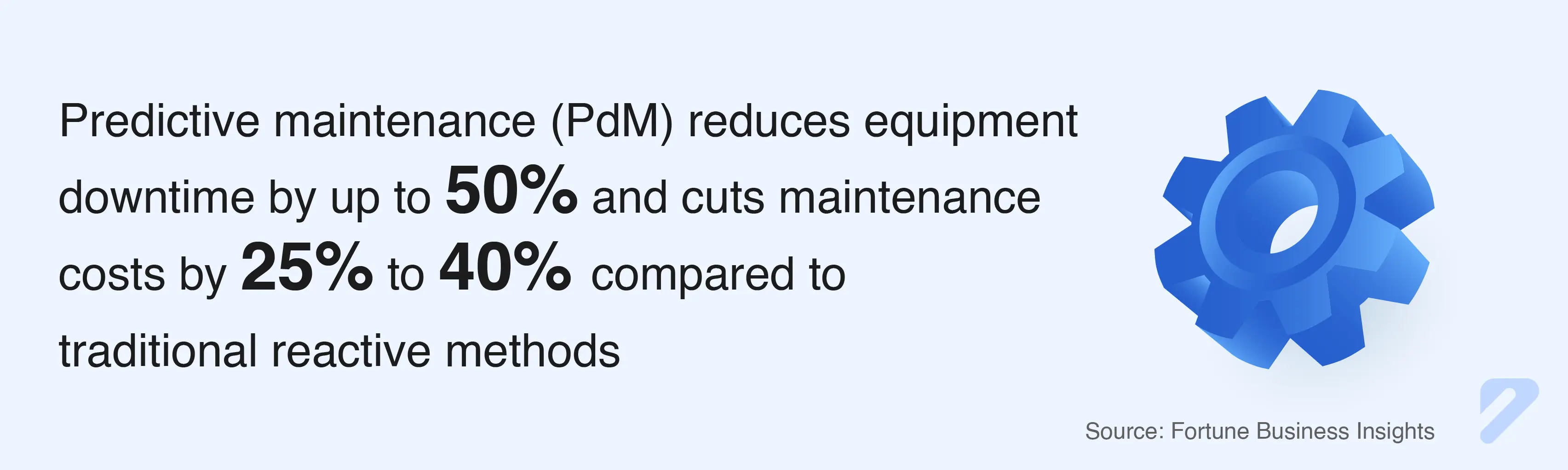
Reactive strategy still dominates. Predictive maintenance, or PdM, which is still in its early stages, shifts the focus from repair to prevention. It keeps a constant pulse on equipment health to detect potential issues.
As companies focus on reducing maintenance costs, more are turning to predictive maintenance.
Internet of Things (IoT)
IoT is one of the technologies that has changed how businesses operate, particularly in industrial environments. Its impact on the latest wave of industrial transformation is hard to ignore. In predictive maintenance, IoT has become a key enabler, connecting machines, sensors, and maintenance teams so owners can spot changes in equipment condition earlier and plan maintenance.
Digital Twins
The virtual replication of products and simulation of their performance prove to deliver substantial benefits in terms of cost. Boeing, for instance, achieved up to a 40% improvement in first-time quality of the parts and systems it uses to manufacture commercial and military airplanes by using the digital twin asset development model.
Simply speaking, it enables engineers to see more of how a product is expected to perform in real conditions, helping them make decisions with greater confidence.
Digital Thread and Data Integration
Industrial AI is gaining attention from industry leaders in their transformation initiatives, in asset-heavy industries such as manufacturing and MRO. Businesses today face a challenge in getting a unified view of assets, limiting their AI initiative.
A digital thread helps organizations maintain data continuity by unifying information across the organization. Better integration can reduce data silos and provide teams with more reliable information.
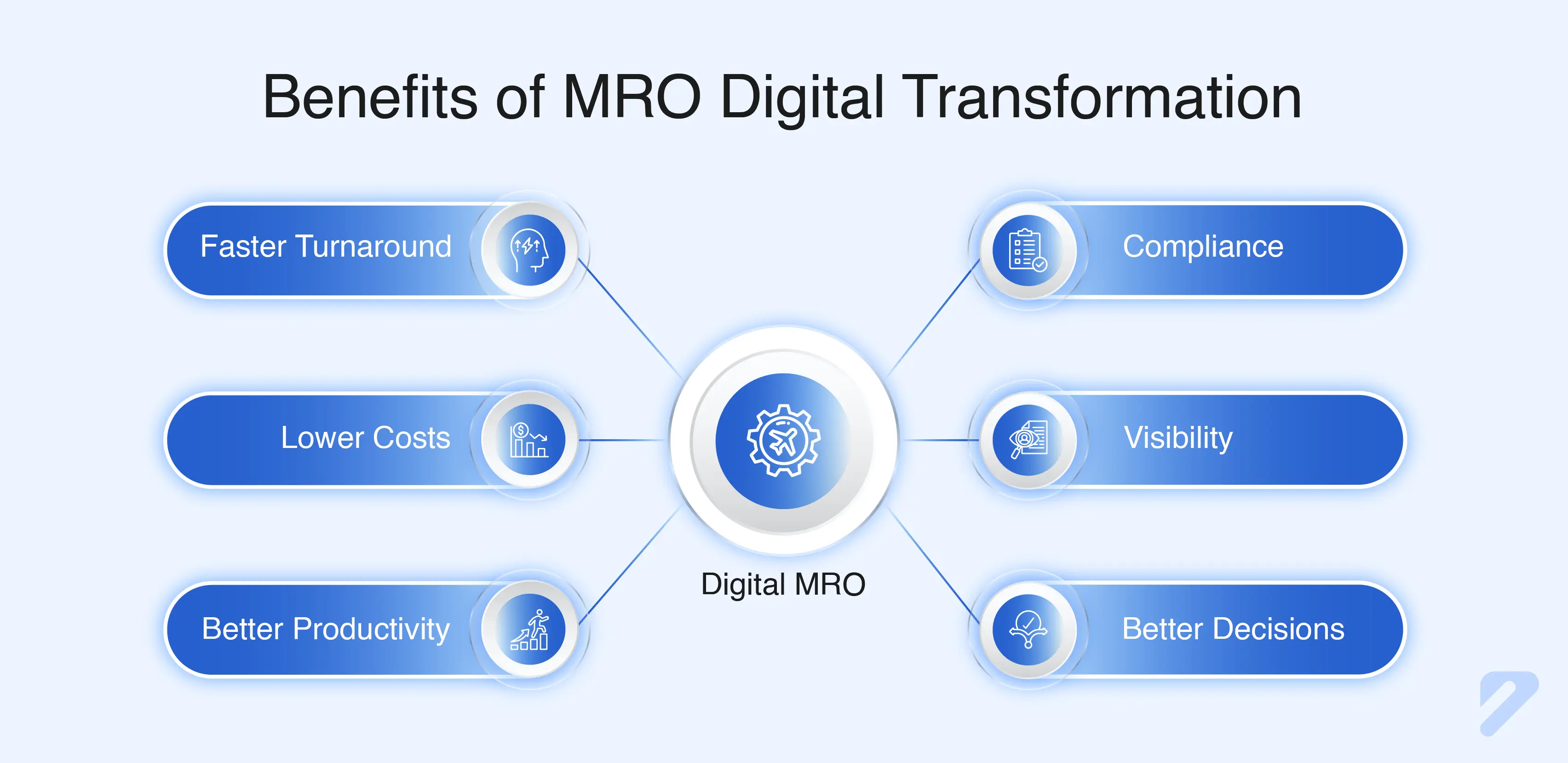
Benefits of MRO Digital Transformation
How to Modernize Legacy MRO Systems
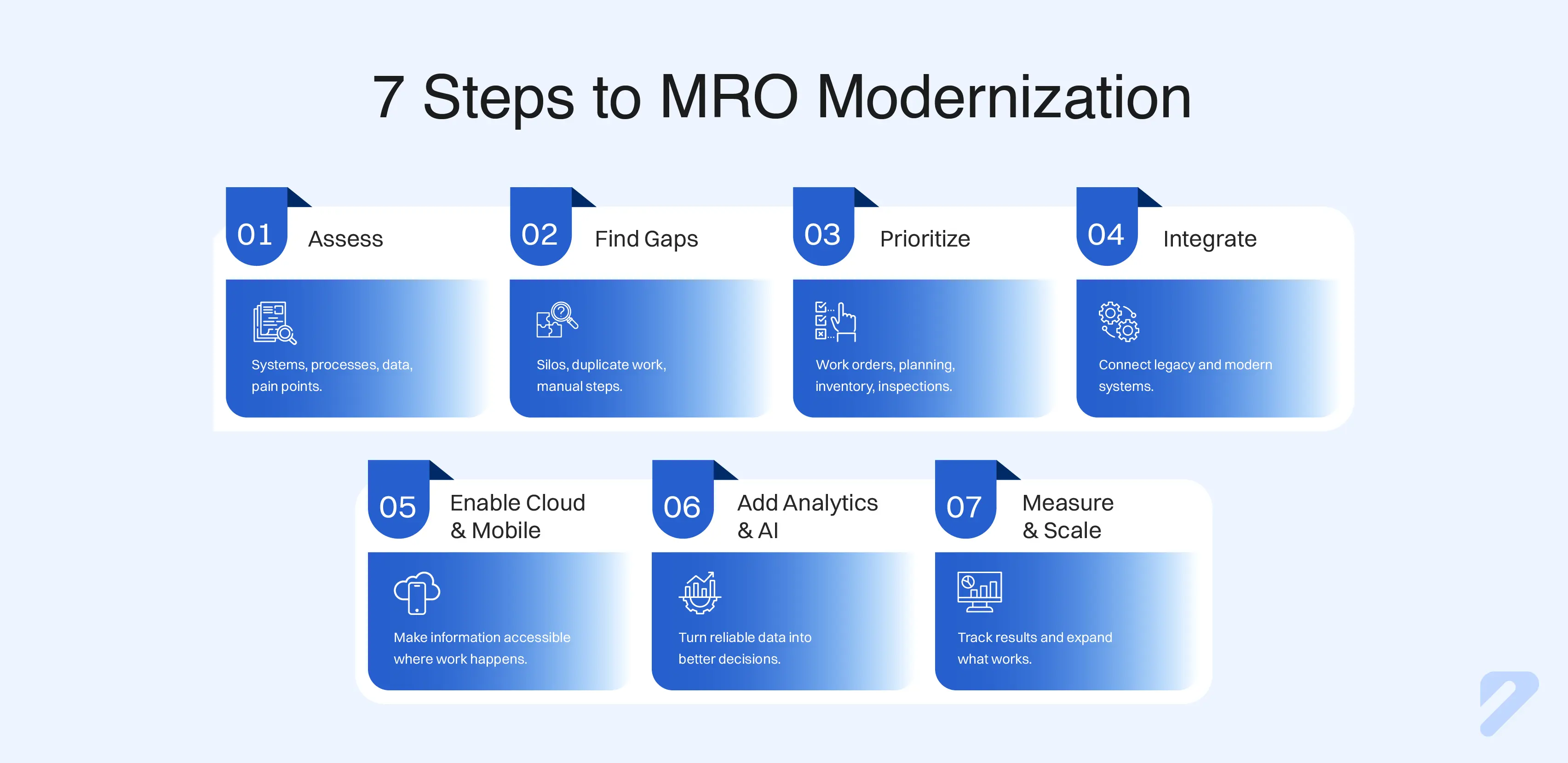
MRO modernization is a strategic move that starts with thoughtful planning and execution. Our detailed guide on MRO modernization covers the bigger picture; here is a high-level overview outlining how leaders can take the next step.
It does not mean replacing every old system immediately. Replacing everything at once will make it hard to manage. A phased MRO modernization strategy can reduce disruption.
The Future of Digital MRO
Industry 4.0 technologies such as artificial intelligence, cloud computing, and machine learning will become a bigger part of everyday operations in the years ahead.
There is little doubt that AI will have one of the greatest impacts on day-to-day operations, as is already evident from the growth of generative AI across multiple areas of business.
As AI technology continues to improve, today's organizations strive to create a connected ecosystem to get the most out of AI into operations and management.
Organizations that successfully make this transition will be better positioned to move from reactive maintenance toward more predictive and proactive operations.

Conclusion
MRO is generating more data than ever but having more data does not make maintenance easier on its own. Amid ongoing supply chain challenges in the MRO, founders are turning to predictive systems to reduce uncertainty around maintenance decisions.
Given the current industry scenario, founders look to fast-track digital transformation initiatives to embed technologies such as AI, digital twins, cloud systems, and predictive tools within operations.
It is important to keep in mind that modernization does not have to start with replacing every system at once. The goal is fairly simple: fewer gaps between what is known, what is recorded, and what the maintenance team actually needs to do.